|
|
by Daniel Devine May 30 12:00 PM
 In a unanimous vote Tuesday, the government of Camden, Australia, rejected a proposal for the building of a 1200-student Muslim school in the quaint old town of 50,000 on the southwest edge of Sydney. The reason for the rejection, according to Camden mayor Chris Patterson, was “clearly a site issue” that involved traffic considerations and had nothing to do with religion. But given the public outrage that the Islamic school proposal has elicited from Camden citizenry in recent months, thrusting the historical town into international headlines, a “site issue” may be hard for some to believe. At last Tuesday’s vote, one resident reportedly said, “We just don’t want Muslim people in Camden, we don’t want them not only here, but we don’t want them in Australia.”
Camden keeps a tight reign on “development applications” (McDonald’s has been rebuffed twice), and when the Sydney-based Quranic Society purchased 15 acres of land and submitted plans for a two-story school, standard procedure included an invitation for public reaction. Of over 3,000 submitted responses from local residents, only about 100 were in favor of the school. At an open-air meeting last November, one thousand townspeople angrily expressed their opposition to the Quranic Society’s school proposal and took the opportunity to rail against the influx of Islam into Australia, intimidating town officials enough that riot police were placed on standby (see this YouTube clip of the event). A few scattered demonstrations in the town have turned ugly—with pig heads impaled on stakes and threats of physical violence toward the proposed Muslim school students. On a larger level, The Independent reported that opposition to the Islamic school was being led in part by Fred Nile, the “leader of a fundamentalist Christian” political party who has opposed Muslim immigration.
Camden’s predicament could be a rare outward manifestation of the tension many Westerners feel as Muslim mosques and schools pop up on traditionally “Christian” soil, obvious reminders of a growing Muslim population among us. There are only about 100 Muslim families living in Camden (the 1200-seat school planned to bus in students from Sydney), and although the town celebrates the “success of multiculturalism in our local community” each year on Harmony Day, residents still bristle at the rustle of a hijab headscarf. Evangelistic-minded Christians have their own decision to wrestle with: Welcome Muslim developments in hopes of building bridges for conversion—or oppose them to stunt Islamic culture’s germination in the West?
Episode three of the Australian Muslim show Salam Cafe makes a joke of the Camden situation (and of the politically correct Mayor Patterson) in an on-site spoof that betrays the attitude Western-bred Muslims have toward perceived “Islamophobes.” What more fundamentalist Muslims might perceive throughout the West is a public decadence conflicting with our supposed Christian convictions, and it certainly doesn’t help that Camden’s website lists local development codes for legal brothels. Could a Muslim school be worse?
Posted in Front Page, The World | 8 Comments »
Camden, islam, Muslim education, Quranic Society
by Cherise Ryan May 3 3:35 PM
An Iran-made movie based on the Islamic version of the life of Jesus is stirring controversy among Christians for its portrayal of Christ as a tormented Judean prophet foretelling the coming of Muhammad, the founder of the Muslim faith.
“Jesus, the Spirit of God,” claims Jesus was compassionate, performed miracles and spoke parables, but was not divine nor was he crucified and resurrected.
Some claim this movie is a step toward bringing more understanding between the two faiths. Director Nader Talebzadeh believes it will show the common ground between Muslims and Christians. He told AFP that he saw his movie as an Islamic answer to Western productions he sees as simply wrong, such as Mel Gibson’s “The Passion of the Christ.”
“I pray for Christians. They’ve been misled. They will realize one day the true story,” Talebzadeh told the LA Times. His film has been screened at international film festivals and is being marketed for wider release.
The film has certainly sparked dialogue, which is part of what Talebzadeh wanted. Bloggers have been disputing the film for months now. In January, one responded to an article about the film saying, “The Islamic-fascists will go to the ends of the earth, whether by blood or bombs, to try to delude their people with their Nazi like propaganda.”
But why be up in arms? Don’t Christians try to spread their version of Mohammad’s life and teachings? In a conversation about this film, one Christian blogger spouted that “Islam preaches hatred of non-believers. Muhammad was a pagan general who created Islam to unify his forces. He only picked and chose what he liked in Judaism and Christianity and added his violent outlook.”
Would Talebzadeh see these comments about his faith the same way Christians view his film? Or would he say they are worse since he at least portrays Jesus as a powerful and kind prophet?
As another blogger more recently commented, “Don’t we as Christians spend our time trying to prove that the beliefs of Islam are false? Don’t get me wrong, I totally disbelieve Islam and what it stands for but, in the same breath, to act as though we don’t try and silence them also is a bit naive. What makes our actions any better than theirs… other than the fact we believe in the true word of God but I am sure they feel the same way about their beliefs?”
Posted in Front Page, The World | 84 Comments »
christianity, interfaith, islam, Jesus the Spirit of God
by Harrison Scott Key May 1 10:01 AM
If you think the U.S. media has treated Obama with kid gloves, at least for most of the campaign, then compare that to how the U.S./European media has treated radical Islam. This is an old story, yes: that the Western media has lionized Islamic fascists as moderates. But this piece in City Journal is a good place to get the whole story of how bad it’s been.
After each major terrorist act since 9/11, the press has dutifully published stories about Western Muslims fearing an “anti-Muslim backlash”-thus neatly shifting the focus from Islamists’ real acts of violence to non-Muslims’ imaginary ones. (These backlashes, of course, never materialize.)
This is probably happening because those who write and edit the news don’t really understand freedom, what goes into its making, and how to preserve it.
The key question for Westerners is: Do we love our freedoms as much as they hate them? Many free people, alas, have become so accustomed to freedom, and to the comfortable position of not having to stand up for it, that they’re incapable of defending it when it’s imperiled-or even, in many cases, of recognizing that it is imperiled. As for Muslims living in the West, surveys suggest that many of them, though not actively involved in jihad, are prepared to look on passively-and some, approvingly-while their coreligionists drag the Western world into the House of Submission.
So, readers, weight in: what particular freedoms do we need to be defending, and - from the angle of Christian philosophy - how should we defend them?
Posted in WorldMagBlog | 16 Comments »
islam, politics, religion
by Clint Rainey April 25 12:00 PM
The Bush administration has floated an inter-agency memo putting the kibosh on words like “jihadist,” “mujahedeen” and “Islamofascist” to officially describe Muslim terrorists, fearing, The Associated Press reports, those words “may actually boost support for radicals among Arab and Muslim audiences by giving them a veneer of religious credibility or by causing offense to moderates.”
“Never use the terms ‘jihadist’ or ‘mujahedeen’ in conversation to describe the terrorists,” the memo reads. Using them to describe terrorists “unintentionally legitimizes their actions.” Instead, “Use the terms ‘violent extremist’ or ‘terrorist.’ Both are widely understood terms that define our enemies appropriately and simultaneously deny them any level of legitimacy.”
The AP got a copy of the memo, which was rumored to be circulating through the Bush administration, and explained that the administration prepared it in March under the auspices of the National Counterterrorism Center and the State Department approved it for diplomatic use earlier this week. The plan is to distribute it to all U.S. embassies.
The memo aims to control officials, loose-lipped or otherwise, who address terrorism publicly, like those in embassies. A bit patronizingly (and debatably), the memo says that while Americans may understand “jihad” to mean “holy war,” it is, in fact, a broader Islamic concept of the struggle to do what’s good. So it urges officials, “don’t take the bait” when addressing, say, statements by Osama bin Laden. Officials should “offer only minimal, if any, response to their messages,” it adds, because “[w]hen we respond loudly, we raise their prestige in the Muslim world.”
Conservative critics, not surprisingly, are calling this a retreat in the war on the War on Terror’s phraseology—an inane back-and-forth that has erupted anew almost every time terrorists or their activities have been publicly described. President George Bush took repeated heat for his persistent use of descriptors like “Islamofascist” for groups like al Qaeda. His administration has since tweaked the wording for the War on Terror (which theretofore may or may not have included the modifier “Global”). Officials recast it as the Global Struggle Against Violent Extremism in 2005, then even more euphemistically essayed the “long war” (in Bush’s 2006 State of the Union).
Concerning America’s partners in the “war,” Britain long ago rejected referring to a “War on Terror” and now even employs the strange contradiction in terms “anti-Muslim activity” to refer to terrorist activities carried out by . . . Muslims terrorists. “Security officials believe that directly linking terrorism to Islam is inflammatory, and risks alienating mainstream Muslim opinion,” England’s Daily Mail explained in January when this new strategy was announced. (Though Gordon Brown’s move, coming under heightened scrutiny ironically in light of news that England has foiled 15 terror plots since 2000, to hold terrorist suspects for more than the allowed 28 days without charge has been angrily denounced as Bush-esque.)
John McCain, meanwhile, received an angry missive last week from the Islamic Society of North America (previously an unindicted co-conspirator in the Holy Land Foundation trial) that demanded the senator stop describing terrorists as “Islamic” and opt instead for a “word that is more acceptable to the Muslim community.” The suggested alternative: “criminal.” McCain’s staff says he’ll just stick with “Islamic.”
Posted in Front Page, The World | 7 Comments »
islam, terrorism
by Clint Rainey March 28 12:00 PM
The controversial anti-Islam short film Fitna, by Dutch politician and cineaste Geert Wilders, was finally released last night to wide abhorrence and applause on the Internet. After having his own site shut down and finding no other takers, Wilders posted it on his political party’s Web site.
Roughly 16 minutes in length, the film (available here, though not for the faint of heart), set to Tchaikovsky’s somber “Arab Dance” from The Nutcracker, quotes suras from an open Koran. Its pages flip, moving from past Muslim terrorist acts to a hypothetical dystopian future ruled by those behind such attacks. It episodically highlights news clips, Muslim-man-on-the-street interviews, montages of mangled bodies, honor killings, terrorist beheadings, vitriolic speeches made by imams and shots of planes careering into the World Trade Center and of the London Tube bombings.
But with its low-grade picture quality and its video clips and news headlines cherry-picked for their anti-West treachery, Fitna (which in Arabic is sometimes translated as “disagreement” or “strife”) is likely to strike many Americans as anti-Islam agitprop from an amateurish right-wing Michael Moore. Indeed, Wilders’ critics fume that he’s little more than a Muslim hater, paradoxically calling for the banning of the Koran while holding out his right to liken it to Mein Kampf.
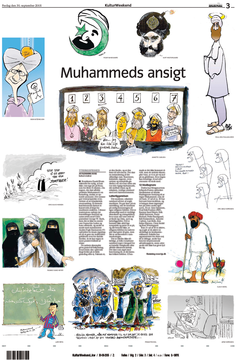
Early reports speculated that the film might even feature a burning Koran, just for the shock value. It didn’t. It opens with a shot of the now-famous Jyllands-Posten cartoon where Muhammad’s turban is a fused bomb, but the closest Wilders comes to a desecration of his own is the final scene: A disembodied hand grabs a page of the Koran, and the camera fades to black. Paper is heard ripping. Subtitles explain: “The sound you just heard was a page being removed from the phonebook. For it is not up to me, but to Muslims themselves, to tear out the hateful verses from the Quran.” (Americans still wince at the revenge bloodshed following Newsweek’s ultimately retracted story about a Koran that was flushed down the toilet at Guantánamo Bay.)
The film’s purpose, Wilders has said, is to be a siren call to the Netherlands, where the film notes the number of Muslims has risen from 1,399 in 1960 to almost 1 million. It ends with the message: “Stop Islamisation.” Since an Islamist brutally murdered filmmaker Theo van Gogh in 2004, Muslim violence has become a major issue for the Dutch.
Wilders has drummed up months-long publicity and amassed no shortage of defenders. Republican Rep. Peter Hoekstra, who was born in the Netherlands, defended Wilders’ right to free speech—no matter how offensive—in Wednesday’s Wall Street Journal, arguing the West can’t “appease the radical jihadist movement . . . by granting them special protection from criticism.”
Because of death threats, though, Wilders lives under armed guard. In the lead-up to the film’s release last week, Network Solutions, which hosted the domain for Fitna’s original site, fitnathemovie.com, shut the site down to review a potential “violation of the Network Solutions Acceptable Use Policy.” Yet it turns out that, up until Wednesday, the company had no qualms about hosting sites for terrorist groups Hezbollah and Hamas.
The Netherlands Islamic Federation, meanwhile, says it plans to petition a district court in The Hague today to ban Fitna for blasphemy. “No preventative ban on any product whatsoever has ever been imposed in the Netherlands,” reports the Dutch new service NIS News.
Posted in Editor's Choice, Front Page, The World | 18 Comments »
Fitna, Geert Wilders, islam
by Mickey McLean March 28 9:47 AM
For Muslims, a baby in a mother’s womb is considered a human being at four months and its death should be handled the same as an adult, which includes a ceremonial washing and shrouding of the body and prayers. But this proved to be impossible for a Muslim couple in North Carolina who claim in a lawsuit that a Greensboro hospital disposed of the remains of their stillborn child despite their verbal and written requests. The couple’s attorney told the News & Record of Greensboro, “Issues of faith are so deeply held. The idea of the loss of eternity … it’s almost hard to come to grips with.”
Posted in WorldMagBlog | 34 Comments »
islam
by Anthony Randazzo March 27 4:19 PM
Turkish Christians are close to losing an unconventional but important ally. The Constitutional Court in Ankara is threatening to close the Justice and Development Party (AK Party) in the name of secularism. Many consider the party Islamist, but the party leaders claim to advocate for religious liberty, offering political protection to minority groups such as Christians, Armenians, and Syriac Orthodox Church.
The AK Party, which gained power in 2002 on a progressive, pro-market, pro-EU platform, is accused of violating Turkey’s longstanding tradition of separating the secular state from Islamic policy. Prime Minister Tayyip Erdoğan, whose wife covers her head as a sign of Muslim piety, has been indicted along with other AK Party officials. They could be banned from politics if the Constitutional Court rules against them and shuts the party down.
Secularist leaders in the government and Constitutional Court, mostly appointed by a previous secularist President, are concerned about the AK Party leading an Islamic Revolution similar to Iran’s in 1979. Boğaziçi University politics student Uğurcan Aksoy told WoW, “They are not working for the whole people anymore.” He believes the AK Party has a hidden agenda and is corrupt: “They have managed to suppress the army (with their Parliamentary majority), which is a very effective institution in Turkey.”
Aksoy is not alone in his beliefs. But the AK Party argues that it is trying to lift restrictions on religious practice and give people freedom to follow Islam, not subtly force conversion. They said the recent headscarf debate at Turkish universities was about allowing Muslim women to practice personal piety, not forcing them to wear headscarves.
On legal grounds, Gazi University Professor Mümtaz’er Türköne said Wednesday, “the indictment completely destroys the system of checks and balances between legislation, enforcement and the judiciary.” The AK Party will seek a constitutional amendment in Parliament to make it more difficult to close a political party. This amendment is the AK Party’s best chance to stay in power.
Religious liberty and secularism are at tension in Turkey, but many argue Turkey’s secularist worldview is a safety net. The Turkish state is safe from rising Islamism because the country has a vibrant new middle class that benefits from capitalism, democracy and globalization.
Posted in Front Page, The World | 2 Comments »
islam, Justice and Development Party, secularism, Tayyip Erdogan, Turkey
by Clint Rainey March 24 12:10 PM
Magdi Allam — a prominent Italian journalist and lapsed-Muslim firebrand whose book titles, Viva Israele (“Long Live Israel”), have won him labels like the “Muslim Zionist” —converted to Catholicism over the Easter weekend. For security, Allam and the Catholic Church kept the news closeted until a few hours before a very public ceremony during Saturday’s nighttime Easter vigil at St. Peter’s, where Pope Benedict XVI himself performed Allam’s baptism.
Allam, whose notable print and TV oeuvre has criticized Islam’s extremist elements, called his conversion “the happiest day of my life” and explained the next day in Corriere della Sera, the influential newspaper where he is deputy editor, that he was escaping religion where “the root of evil is innate.” Islam, he said, “is physiologically violent and historically conflictual.”
The penalty in Islamic jurisprudence for apostasy is death, which is why Allam already has 24-hour security guards, à la apostates like Salman Rushdie and Ayaan Hirsi Ali. But many Muslim organizations are loath, for obvious reasons, to publicize this penalty.
Even though very few would actually enforce it, and even though it isn’t found in the Koran, but rather comes from several hadith, all major schools of Islamic jurisprudence defend it. The renowned sheikh and mujtahid Yusuf Al-Qaradawi Allam plainly admits, “The four main schools of jurisprudence . . . as well as the other four schools of jurisprudence . . . agree that apostates must be executed.”
But, so far, Allam’s conversion doesn’t have Muslim leaders bristling with denunciations. Issedin El Zir, spokesman for the Union of Islamic Communities (a group Allam has criticized for ties to Hamas), told The Associated Press that Allam “is an adult, free to make his personal choice.” Yahya Pallavicini, vice president of Coreis, an Islamic religious community group in Italy, told Reuters he respected Allam’s choice.
The dearth of attacks could stem from the fact that Allam had been a non-practicing Muslim for most of his life and even has a Catholic wife. Although he went on the hajj (pilgrimage to Mecca) as a child, he admits to never making salat (the five daily prayers) and ignoring sawm (the fast during Ramadan), two of the five pillars of Islamic faith.
These strikes against him, says Jihad Watch blogger Hugh Fitzgerald, give Muslim leaders an opportunity to marginalize Allam’s conversion. “It’s nonsense, but it is the only way Muslims will have to deal with his scathing, unanswerable criticism of Islam and of many Muslims . . . with his conversion to Christianity,” Fitzgerald writes, “since they cannot deal with either the way they would dearly like to, if they could only get their hands on him. Their only recourse is to pretend he was a Christian ‘all along’ and the ‘Pope of the Vatican’ engineered the whole thing.”
Allam’s baptism comes only three days after Osama bin Laden’s latest message: that the Pope is leading a “new Crusade” against Islam, citing the Jyllands-Posten cartoons of the Prophet Muhammad as proof. Like the Netherlands—whose latest bout of Muslim thuggery surrounds the work of (another) filmmaker and cineaste Geert Wilders for his short film Fitna (whose Web site, containing only the words “Geert Wilders presents Fitna, 23 March 2008,” was shut down late last week for “violation of the Network Solutions Acceptable Use Policy”)—Italy is becoming the epicenter of a radical cultural divide bisecting Western civilization.
Posted in Front Page, The World | 7 Comments »
islam, Magdi Allam, Muslim conversion
by Anthony Randazzo March 19 12:00 PM
Every religion has its times of upheaval. The 16th Century Protestant Reformation shook the Church to its core, and now Islam may be experiencing its own Reformation.
Stroll through Istanbul or Beirut and you’ll see Westernization everywhere, from clothing to music trends. Flip on a satellite TV, and you might stumble upon one of these reformers: Moez Masoud. This 29 year old Egyptian challenges the Islamic world with a message of love, compassion and tolerance, and his programs are attracting millions.
Masoud is part of what some call an Islamic Reformation promoting an upbeat, modernized interpretation of the faith. Masoud says that “imams who outlawed art and music were misinterpreting their faith.” He believes that “art, culture and music should be appreciated,” bringing vibrancy to a religion descending into radicalism. Masoud’s modern tone, with ideas like allowing dating while still rejecting sex before marriage, stands in contrast to the traditionalists calling for a return to orthodoxy.
Sheikh Moussa Drammeh, another forward thinking Muslim, actively condemns violent Islam. “We living in a community,” he told WoW, “and we need to respect each other.” Drammeh helps runs a community program, the Jamhiyatut Tahaawun Islamic Center, in the north Bronx. He is also involved in taking teen gang members off the street and putting them in Wall Street internships.
Globalization brings the world’s ideologies face to face. Since the fall of the Ottoman Empire, Muslims around the world have been grappling with how to adjust. In face of a global Jihadist movement, Muslims like Masoud and Drammeh are crucial for developing a peaceful tone in Islam.
Posted in Front Page, The World | 3 Comments »
globalization, islam, moderate Islam, Moez Masoud
by Harrison Scott Key February 8 11:01 AM
Jerry Gordon at The New English Review writes a fascinating article of multi-culture-shock. It’s really a case study of what happens when a tribal community of Muslims find their way to a small-town community of Tennessee. The Enlightenment ideal of pluralism is one thing. The 21st century reality of it is another. The article is an interview with Brian Mosely, a writer for the small newspaper of the small town of Shelbyville, Tennessee. He’s spent a long time covering the Somali community who was brought in by Tyson Chicken to work in the factory. He said this when asked about the difficulties of such an arrangement:
There are so many difficulties; it’s hard to know where to begin. At the top of the list would have to be the attitude of the Somali refugees, which locals have consistently described as ‘rude and demanding’. This description comes from practically everyone who have encountered or interacted with them, from your average convenience store clerk all the way to law enforcement officers and other officials.
Given that this area of Tennessee is known for their southern hospitality, the behavior of the Somalis has really angered many people in the community, even those who would typically welcome people from other cultures. But what is really infuriating many residents are that the groups who bring the Somalis into the country appear to expect the local community to practice the same type of moral and cultural relativism they do.
For example, when asked about the ‘rude and arrogant’ behavior, the head of Catholic Charities said that ‘this is just the Western perception of the Somali culture.’ She claimed that since the Somalis have been refugees for so long, it is only through being rude and demanding that they have managed to get the little they have gotten to survive over the years in the camp.” However, these types of explanations have not been well received here at all. I hear a lot of variations on the phrase, ‘when in Rome…’ from the public, although many others have been quite a bit more direct about expressing their feelings.
It gets worse. They don’t seem to like firefighters, police officers, and female school administrators, among others.
Posted in WorldMagBlog | 59 Comments »
culture, islam, politics

|
|


 More Active Posts


 Front Page


 Politics of fraud